Finding My Frequency
A record built from emotion, alternate tunings, room sound, improvisation, and the search for a frequency that could say what words could not.
Listen on SpotifySinger songwriter · guitarist · independent artist
Songs, improvisations, and recordings that move through indie, alternative, acoustic, ambient, experimental, drone, and whatever the moment needs to become.
About
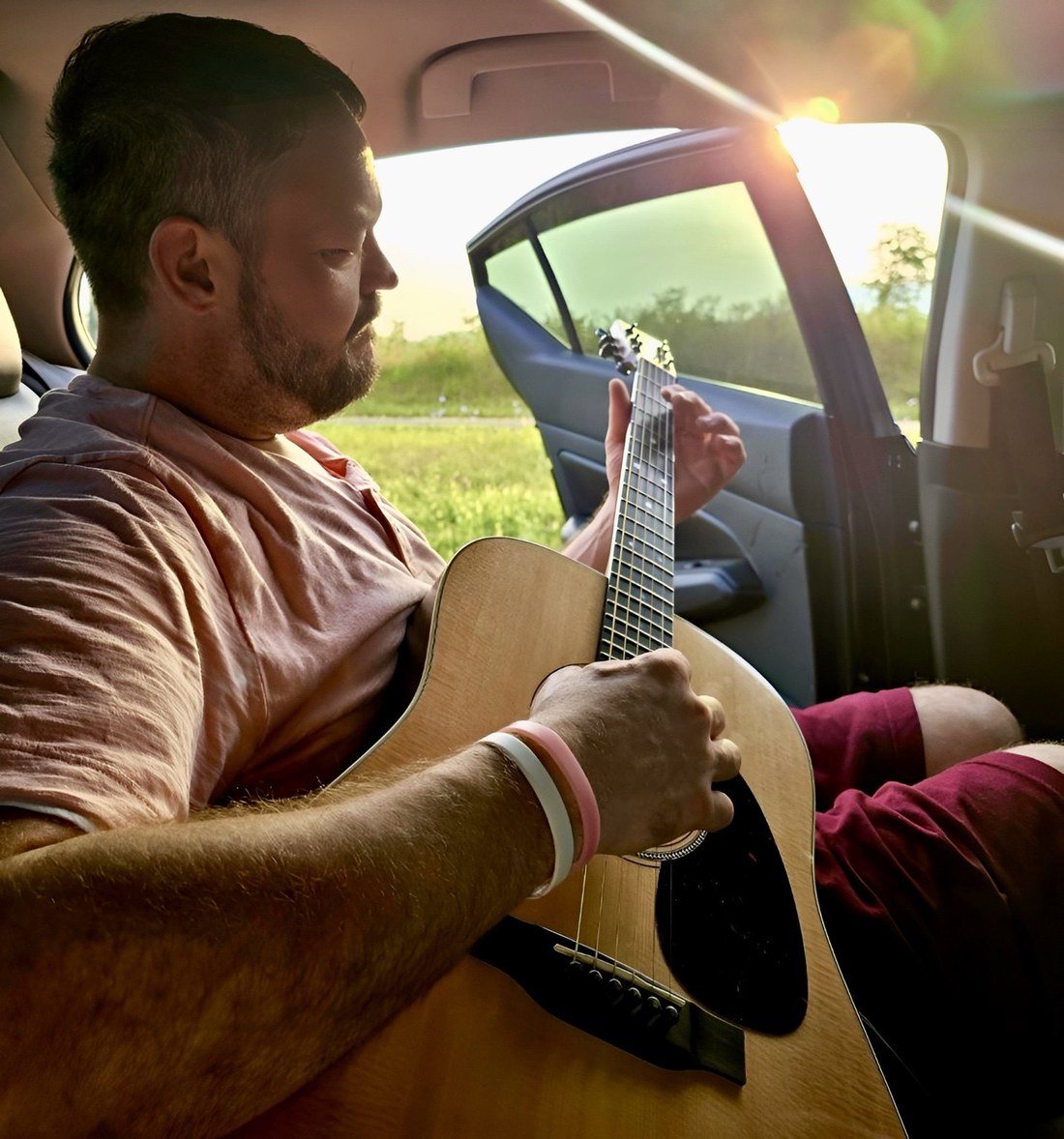
John Leonard is a singer songwriter and guitarist whose work moves between written songs and moments that happen once and are left exactly where they landed.
His music crosses indie and alternative songwriting, acoustic guitar, ambient improvisation, drone, experimental sound, and long stretches that resist being forced into a genre at all.
He is self taught and plays by ear. Some pieces begin with words. Others begin with a feeling, a room, or a single string that needs to sound different before anything else can happen.
Michigan · Winter 2026
An empty house gave the music somewhere to speak.
Much of the music that became Finding My Frequency began during the dead of winter in Michigan in 2026. Leonard was there doing work on a completely empty home built in the 1960s, as well as another property for close family friends.
The house had old wooden floors, bare rooms, an empty basement, and an empty garage. With no furniture, rugs, or people absorbing the sound, every room answered the guitar differently. One could feel close and dry. Another opened into long natural resonance. The basement had its own voice. The garage had another.
Night after night, often from the middle of the night until dawn, he would pick up the guitar with no fixed tuning, progression, or song in mind. The notes came from whatever mood he was carrying. If the night felt sad, depressed, or lonely, the instrument was going to sound that way too.
He would begin with the low E string and work upward, changing one string at a time by ear until the frequencies coming back from the guitar matched what he was feeling. Dark and unresolved when that was where his head was. He was not looking for the correct tuning. He was listening for the point where something inside him began to loosen.
The guitar became a way to say what he could not articulate. The loneliness that brought him to it also became part of what it helped him carry.
There was nobody in the next room, nobody to impress, and nobody whose judgment he had to anticipate. That privacy changed everything. He could stop holding back and let the room, the tuning, and the emotion decide what happened next.
These recordings are less like songs to recreate and more like moments in time. The person, room, hour, tuning, and feeling existed together once. The recording is what remains.
Music
A record built from emotion, alternate tunings, room sound, improvisation, and the search for a frequency that could say what words could not.
Listen on SpotifyVoice, guitar, atmosphere, songwriting, and the space between what gets said and what stays unresolved.
Listen on SpotifyThe process
There is no fixed recipe. A recording might start with a lyric, a mood, a room, or the need to change one string. Tunings are often found by ear and shaped around the emotion of the moment. The room is allowed to matter. When a performance captures what needed to come out, it can stay finished without being rebuilt into something cleaner.
Sadness, loneliness, tension, calm, or whatever is present determines where the tuning begins and where it needs to go.
Starting at the low E and moving upward, each string changes until the instrument feels emotionally right rather than theoretically correct.
Wood floors, basements, garages, caves, vans, pavilions, and empty rooms all leave different fingerprints on the recording.
Many recordings are captured in a single continuous performance. They are not meant to be duplicated exactly, and there is no desire to force them back into existence later.
A benchmark recording
Fayette City Cave became an important point in the catalog because it showed how much could happen when the guitar, the natural space, and the performance were allowed to exist without being polished into something else.
Listen and follow
Press
Bio, release information, official photos, artist references, and links are collected in one clean press page.
Open the EPK